Moving to Sacramento: A Relocation Guide
Sacramento is where a lot of people who leave the Bay Area actually land: 536,449 residents, up 2.2% since 2020, with a median home value of $506,300 against $1.23 million in San Jose. Here is what the neighborhoods mean for a move, what it costs, whether the Bay Area commute works, and what changes on move day.
Sacramento in numbers
Sacramento is where a large share of people who leave the Bay Area actually end up. The city had an estimated 536,449 residents as of July 1, 2025, up 2.2% since April 2020 — one of the strongest growth rates among California cities in a period when the state overall shrank slightly.
From Census Bureau QuickFacts:
- median household income: $87,321 (2020–2024, in 2024 dollars);
- median gross rent: $1,779;
- median value of an owner-occupied home: $506,300;
- homeownership rate: 51.7%;
- persons per household: 2.59.
That home value figure is the headline. A median house in Sacramento costs roughly 40% of a median house in San Jose, in the same state, about 90 minutes from the Bay Area.

Why people move here
The trade is explicit: give up proximity to Bay Area job centers, get a house.
Sacramento works because it is not only cheap. It is the state capital, so government employment is large and stable. UC Davis Health and Sutter anchor a substantial healthcare sector. The region has a real agricultural and food economy, and a growing share of residents who kept a Bay Area job and now commute two or three days a week.
It also has trees, rivers, and a downtown that has genuinely improved over the past decade. What it does not have is the Bay Area’s summer climate — July and August routinely run above 95 degrees.
Neighborhoods, and what each means for a move
Midtown and East Sacramento. Victorians, bungalows, and tree-lined grid streets. Beautiful, and often a narrow driveway, a raised porch, and mature trees that a high-cube truck has to work around.
Land Park and Curtis Park. Older homes near the park, similar access constraints, popular with families.
Downtown and R Street. Apartments and lofts, some with freight elevators and reserved move windows.
Natomas. Newer housing, wide streets, garages, straightforward access. Built on former floodplain, so flood insurance is a normal part of the conversation.
Elk Grove, Folsom, Roseville, Rocklin. Suburban, master-planned, HOA rules on move hours and truck placement. See Roseville.
Oak Park and Tahoe Park. Older, more affordable, mixed housing stock and changing quickly.
What it costs
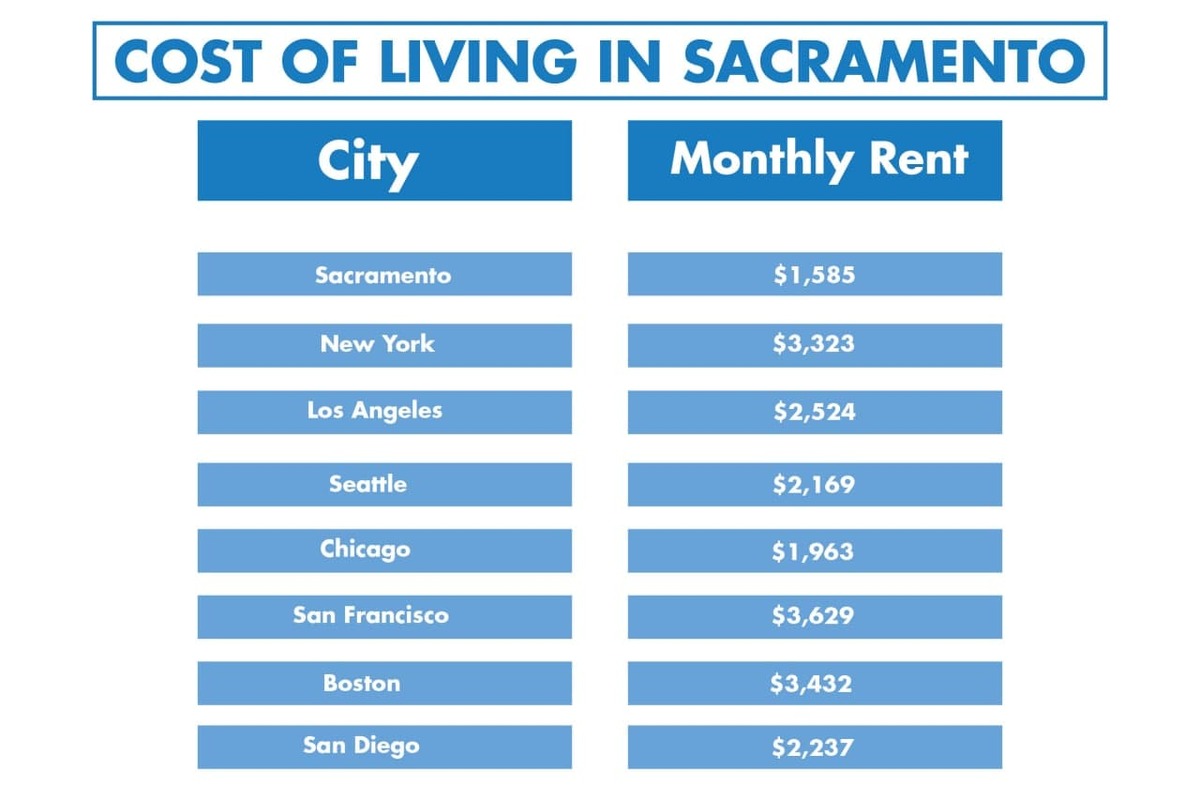
Sacramento is affordable by California standards and ordinary by national ones. Rent at $1,779 is roughly a third below San Jose. The tradeoffs show up elsewhere:
- Summer cooling. Air conditioning runs hard from June to September, and SMUD bills reflect it. SMUD is a municipal utility, which generally means lower rates than PG&E territory.
- Water. Charged by the city, with usage-based billing in most areas.
- Sales tax. The 7.25% statewide base plus local district taxes, per the CDTFA.
- Transportation. Light rail and buses exist, but most households drive.
- Flood insurance in parts of Natomas and along the rivers. Check the requirement before you commit to an address.
The Bay Area commute question
If you are keeping a Bay Area job, this decides everything.
The drive to San Francisco is roughly 90 miles on I-80 and takes about 1 hour 40 minutes with no traffic, which is not a condition I-80 offers at rush hour. The Capitol Corridor train runs to Emeryville and Oakland with a bus connection into San Francisco, and it is the option most people who commute regularly settle on.
Two or three days a week is workable. Five is not, and people who try it usually move again within a year.

What makes a Sacramento move different
- Heat. Summer moves start at 6 or 7 in the morning for a reason. Above 100 degrees, an afternoon load is slow and hard on both crew and contents.
- Bigger homes, more stuff. Households moving from the Bay Area usually arrive with less than the house can hold, then fill it. Households moving out of Sacramento are often downsizing hard.
- Old trees and narrow driveways in Midtown and East Sacramento. A 26-foot truck does not always fit where a photo suggests it will.
- HOA rules in Elk Grove, Folsom, and Roseville set move windows and where the truck can stand.
- The 90-minute corridor. A Bay Area to Sacramento move is usually a single-day job with an early start, not an overnight one.
Moving from the Bay Area to Sacramento
This is a same-state, same-day route, and it is normally priced either hourly with travel time or as a flat rate against a confirmed inventory. Which one fits depends on the size of the move and how predictable the access is at both ends.
Our standard hourly package is $175 per hour for two movers and one truck, including disassembly and reassembly, moving blankets and furniture protection, mattress protection, standard protection for TVs, mirrors, artwork and electronics, floor and doorway protection, loading, transport, unloading, placement, three reusable wardrobe boxes, and dispatcher coordination. For a larger house, a flat rate against a confirmed inventory usually gives a cleaner answer.
For a move inside California, the terms come from your move documents and the state rules published by the Bureau of Household Goods and Services. If you are arriving from out of state, the FMCSA sets out the two valuation options.
California Movers USA runs the Bay Area to Sacramento corridor with in-house crews. See San Francisco to Sacramento moving, Sacramento movers, and pricing.
Related reading: San Francisco population and migration, cost of living in San Francisco, moving to California, and setting up utilities.
Questions people ask
Is Sacramento growing?
Yes — up 2.2% between April 2020 and July 2025, against a 0.5% decline for California overall.
How much cheaper is Sacramento than the Bay Area?
The median owner-occupied home is $506,300 in Sacramento against $1,233,200 in San Jose. Rent is roughly a third lower.
Can I commute to San Francisco from Sacramento?
Two or three days a week, realistically, by car or the Capitol Corridor train. Daily is about 3 to 4 hours of round-trip travel.
How hot does it get?
Regularly above 95 degrees in July and August, sometimes above 105. Winters are mild and often foggy.
Is flooding a real concern?
In specific areas, yes. Check the flood zone and the insurance requirement for the exact address before you commit.
How long does a Bay Area to Sacramento move take?
Usually one day, with an early start. Access at both ends matters more than the 90 miles between them.
Figures from U.S. Census Bureau QuickFacts and CDTFA; reviewed September 2026.
Tell us what you are moving and we will come back with a starting quote.