Furniture Movers in California
Most furniture jobs fail on one question, and it is not how heavy the piece is. It is whether it fits. California Movers USA moves single pieces and whole rooms across California at $175 per hour for two movers and one truck — but the useful part of this page comes before the price. It is how to measure a sofa, a door and a staircase before you book, so that nobody discovers on the day that the only way in is through a window.
GET A FREE QUOTE NOW!
What our beloved customers are saying
Diana
Customer
Adrian Austin
Manager
From:
Irvine
To:
Oakland
Yelp
Movers and company’s representatives are very knowledgeable. My furniture is antiques and very expensive. Firstly, I needed to storage my furniture for some time, while I was abroad. After that, I used California Movers’ service to move this furniture to my new house. Everything was perfect, from storage to move. Careful and professional movers made my move easy and stress-free. I will use this moving company in future.
Cyndi
Customer
Adrian Austin
Manager
From:
San Jose
To:
Sacramento
Yelp
We hired California Movers to move our parents’ furniture from San Jose to Sacramento. The movers were very prompt, efficient, and took excellent care of the antique furniture and plants. I highly recommend them and will definitely hire them again when the need arises.
Chloe
Customer
Adrian Austin
Manager
From:
Antioch
To:
Rialto
Yelp
California Movers were very professional. They loaded the truck much faster than expected and everything was wrapped nicely. I paid the same amount that was agreed with the moving representatives. I was very glad to work with them!
Services That Sit Beside a Furniture Move
Each of these is quoted as its own line, so you can see exactly what it adds to the job.
Three things that are often quoted wrongly elsewhere. Packing and unpacking on a local move are billed at the same hourly rate rather than as a separate service, and cartons and packing paper are not charged. A piano, a safe, oversized art or gym equipment needs more hands rather than a specialty fee — the crew changes, so the rate does: $175 an hour for two movers, $270 an hour for a crew of four. Extra pickup or delivery stops add time at that same rate, with no flat surcharge.
Appliances have to be disconnected and drained before the crew arrives — California Movers USA does not disconnect or reconnect gas, water or electrical appliances. A certificate of insurance for your building is issued on request at no charge, and California Movers USA books a three-hour minimum on local moves.
Local Moving
Learn More
When it is the whole home rather than a few pieces, billed hourly with the access planned in.
Apartment Moving
Learn More
Lifts, certificates of insurance and parking permits, settled before the date is held.
Piano Moving
Learn More
Specialty handling on a skid board, with the crew size set at a survey rather than guessed.
Storage
Learn More
Partner warehouse with climate control, and pickup, storage and redelivery quoted separately.
On This Page
What a Furniture Move Covers
A furniture move is anything short of a whole household: one piece, one room, or the awkward half of a move you would rather not do yourself.
- A single heavy or valuable piece between two addresses
- A delivery you have bought — showroom, warehouse, marketplace or auction
- Moving pieces between rooms or floors inside one home
- Clearing a room before flooring, painting or a renovation, and putting it back after
- Loading or unloading only, into your own vehicle or a container
- The heavy items on a move where you are handling the boxes yourself
If the whole home is moving, the local moving page covers that work; if it is an apartment with lifts and permits in play, the apartment moving page is the one that answers those questions.
Will It Fit? Measure This First
This is the question that decides whether your furniture move is an hour or a problem, and it is entirely answerable with a tape measure the week before. Measure the piece, then measure the tightest point on the route.
| Measure | Why it matters | What to expect in a California home |
|---|---|---|
| Doorway width, frame to frame | The narrowest point on most routes. Taking the door slab off its hinges typically gains an inch or more | Interior doors are commonly 30–32 inches; measure yours rather than assuming |
| The piece's diagonal depth | The number that actually decides a sofa. Measure from the highest point of the back, diagonally, to the front edge of the seat | If the diagonal depth is less than the doorway width, the sofa goes through on its side |
| Stairway width | Sets the widest piece that can be carried up or down at all | Stairways in dwellings must be at least 36 inches wide |
| Headroom over the stairs | Decides whether a tall piece can be tipped on the flight | Minimum 80 inches, measured vertically from a line joining the nosings |
| The landing | The real limit on anything long — it is where the piece has to turn | Landings must be at least as wide and as long as the stairway itself |
| Riser and tread | Steep, shallow stairs make a heavy piece far harder to control | Risers up to 7¾ inches, treads at least 10 inches |
| Hallway width and ceiling height | Whether a piece can be stood on end to make a turn | Measure both; a tall wardrobe in a low hallway cannot be tipped |
| Lift car and lift door | Two different numbers, and the door is usually the smaller one | Measure the door opening, the car depth and the diagonal inside the car |
Stairway dimensions are the requirements of the California Residential Code for stairs in dwellings, as summarised in published county building-department guidance. They describe what new work must meet — an older home may not comply, which is exactly why you should measure rather than assume. Confirmed September 2026.
Send those numbers with your quote request, or send photographs of the doorway, the staircase and the landing. California Movers USA would far rather tell you in advance that a piece needs the door slab removed than find it out with the sofa halfway up the flight.
What Comes Apart and What Does Not
Disassembly buys inches, and inches are usually what is missing. But not everything is designed to come apart, and forcing a piece that is not is how furniture gets broken.
Usually comes apart
- Bed frames, slats and headboards
- Table tops from their legs or bases
- Modular and sectional sofas, at the connectors
- Sofa and armchair legs
- Shelving units and flat-pack furniture
- Desks with bolted frames
- Mirrors and glass from cabinets and dressers
- Wardrobe doors, and the doors of the room itself
Usually does not
- One-piece sofas with a solid welded or glued frame
- Recliner mechanisms beyond removing the back
- Older wardrobes with glued joinery
- Marble and stone tops — they lift off, but they never travel flat under weight
- Antique pieces with original joinery, where taking them apart lowers their value
- Anything built in place, which is a contractor's job rather than a mover's
Standard disassembly and reassembly is part of the rate. Hardware is bagged and labeled to the piece it came from, so the same fixings go back into the same frame. If a piece genuinely will not fit by any route, the honest options are a hoist through a window, removing a window sash, or leaving it behind — and all three are decided in advance rather than on the day.
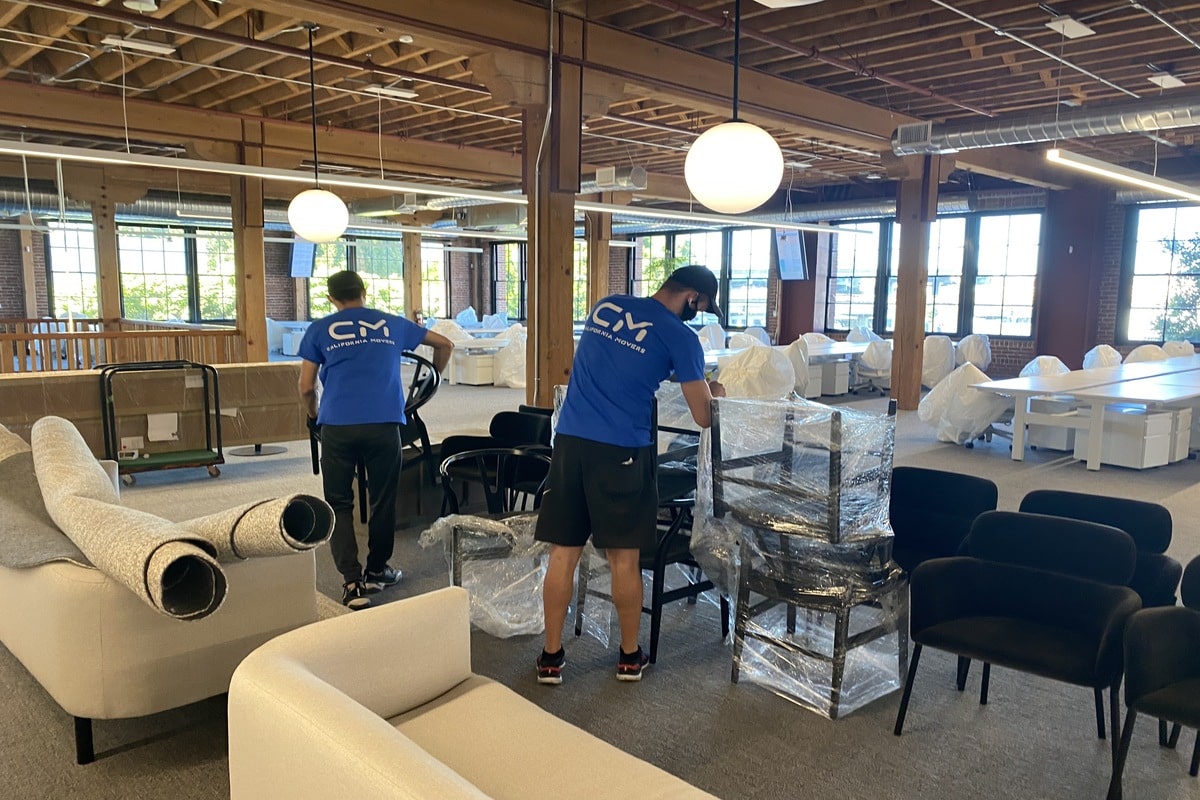
What Furniture Moving Costs
Furniture work is hourly: $175 per hour for two movers and one truck. Two people is the minimum for almost any real piece, which is why a single-item job and a small room often cost more alike than you would expect — the hour it takes to protect the route and get the truck to the door is the same either way.
| What drives the hours | Shorter when | Longer when |
|---|---|---|
| The route | Ground floor, wide door, truck at the curb | Stairs, tight landings, a long carry from the truck |
| Fit | The piece goes through as it stands | Doors, legs or the piece itself have to come off and go back on |
| Preparation | The piece is empty, clear and accessible | Drawers full, items on top, furniture boxed in by other furniture |
| Protection needed | Robust modern pieces | Antique, glass, stone or high-gloss finishes |
| Parking | A legal space near the door | Nowhere to stop, or a permit that was never applied for |
| Number of pieces | One trip fills the truck sensibly | Awkward shapes that waste truck space and force a second run |
Booking documents state any minimum, billing increment and travel rule that apply. A defined single-piece job can also be quoted as a flat price — the pricing page explains when each model is used.
A Sectional Down a Victorian Staircase
A composite built from ordinary California Movers USA work: a three-piece sectional and a marble-topped sideboard leaving a second-floor San Francisco flat — a straight flight of eighteen steps with a turn at the bottom — for a house in Oakland. Three movers, one truck.
Before
Photographs of the staircase, the landing and both doorways sent with the quote request. The sideboard measures wider than the door; the plan is to take the door slab off and remove the marble top. Decided in advance, not at the top of the stairs.
9:00
Crew arrives. Floor runners down, banister padded, both door frames guarded, the turn at the bottom of the flight given a corner protector.
9:20
The sectional is separated at its connectors and the legs come off each piece. Hardware bagged and labeled to its section.
9:45
Each section is pad-wrapped, then shrink-wrapped over the pads — never plastic against the upholstery. Corners doubled.
10:15
Sections carried down one at a time, on their sides, angled through the turn. Two movers carrying, one calling the turn and watching the banister.
11:00
The sideboard: marble top lifted off by two people and carried separately, standing on edge in a padded divider. The carcass goes down with the door slab off its hinges.
11:40
Loaded: heavy and flat low and forward, sections tiered and strapped, the marble upright against the wall of the truck and secured on its own.
12:30
Oakland. Route measured and protected before the tailgate opens.
13:15
Sectional rebuilt in the room, legs back on, sections reconnected, marble refitted and the sideboard levelled.
14:00
Walkthrough, door rehung, padding out, paperwork closed.
What would have changed this
- A sectional that turns out to be one welded frame rather than three sections — a completely different job, and possibly a hoist.
- The marble left on the carcass — stone that travels flat under weight is stone that arrives cracked.
- No photographs at quote stage — the door slab discovered to be the problem at 9:00 rather than at booking.
- Nowhere legal to stop in San Francisco — every section carried an extra two hundred feet, twice.
Composite illustration drawn from routine Bay Area work. Your own crew size and timings are confirmed in writing once the pieces and the route are verified.
How Pieces Are Protected
Protection is not decoration. Each layer answers one specific way furniture gets damaged between a room and a truck.
- Moving pads first, always. Pads go against the piece; wrap goes over the pads. Plastic against a polished or upholstered surface can mark it and trap moisture.
- Corners doubled. Corners take every knock on a staircase, and they are the first thing to go on a wooden frame.
- Glass, mirrors and stone travel on edge in padded dividers, never flat under other weight.
- Drawers empty and taped, or removed and carried separately where the piece is fragile.
- Hardware bagged and labeled to the piece it came from, so reassembly is not a puzzle.
- Floors, banisters and door frames are protected before anything moves — the building matters as much as the furniture.
- Load built in tiers and strapped, so nothing shifts on the drive.
California Movers USA's crews are trained, background-checked employees rather than subcontracted labor, so the people who quoted the job are the people handling the piece.

What the Rate Includes and What Is Quoted Separately
Both lists are settled before you book. Nothing on the right appears on an invoice without your approval first.
In the hourly rate
- The crew and the truck
- Trained, background-checked California Movers USA employees
- Standard disassembly and reassembly
- Pads, shrink wrap, straps, dollies and equipment
- Floor, banister and door-frame protection at both ends
- Taking a door slab off its hinges and rehanging it
- Loading, transport and unloading
- Placement in the room you name
- Basic protection at 60 cents per pound per article
Quoted as its own line
- Crating for high-value or fragile pieces
- A hoist or crane where no route through the building exists
- Removing a window sash
- Storage between two dates
- A shuttle where a full-size truck cannot reach the door
- Valuation above the basic 60 cents per pound
Sixty cents per pound per article is a liability level built into the rate, not insurance — it pays by weight rather than by what a piece cost. That gap matters more for furniture than for almost anything else: an antique chest can weigh eighty pounds and be worth thousands. If a piece is valuable, raise it during the estimate and have the right valuation elected in your move documents.
Storing Furniture
Furniture often needs somewhere to be for a while — a renovation, a gap between homes, a piece that will not fit the new place but is not going anywhere either.
- Storage runs through a partner warehouse, with climate control available — worth asking for with wood, leather and anything veneered.
- Access is around the clock, arranged by calling the office, rather than only in business hours.
- Pieces are stored wrapped, on the same inventory they left on.
- Pickup, the storage period and redelivery are quoted as separate components rather than folded into one number.
The moving storage page covers unit sizes, monthly rates and the difference between storage-in-transit and permanent storage.
Three things that are often quoted wrongly elsewhere. Packing and unpacking on a local move are billed at the same hourly rate rather than as a separate service, and cartons and packing paper are not charged. A piano, a safe, oversized art or gym equipment needs more hands rather than a specialty fee — the crew changes, so the rate does: $175 an hour for two movers, $270 an hour for a crew of four. Extra pickup or delivery stops add time at that same rate, with no flat surcharge.
Appliances have to be disconnected and drained before the crew arrives — California Movers USA does not disconnect or reconnect gas, water or electrical appliances. A certificate of insurance for your building is issued on request at no charge, and California Movers USA books a three-hour minimum on local moves.
Furniture Moving FAQ
How much does it cost to move furniture?
Furniture work is hourly at $175 for two movers and one truck. A single piece and a small room often cost more alike than people expect, because protecting the route and getting the truck to the door takes the same time either way. Your booking documents state any minimum, billing increment and travel rule.
Will my sofa fit through the door?
Measure the sofa's diagonal depth — from the highest point of the back, diagonally, to the front edge of the seat — and compare it with the doorway width. If the diagonal depth is smaller, it goes through on its side. Taking the door slab off its hinges usually gains another inch or more.
What if it does not fit?
In order: take the door off, take the legs off, separate the piece if it is designed to separate. If none of that works, the options are a hoist through a window, removing a window sash, or leaving the piece behind — all decided in advance, never on the day.
Can you move one item only?
Yes. Single-piece jobs are routine, including a delivery you have bought from a showroom, a warehouse or a marketplace seller.
Do you move furniture within the same house?
Yes — between rooms or floors, or out and back for flooring, painting or a renovation. It is the same hourly work without the drive.
Do you take furniture apart?
Standard disassembly and reassembly is part of the rate: bed frames, table tops, sectional connectors, legs, shelving, and glass or mirrors that lift out. Hardware is bagged and labeled to its piece.
What about a marble or stone top?
It comes off and travels separately, standing on edge in a padded divider. Stone that travels flat under other weight is stone that arrives cracked.
How do you protect an antique?
Pads against the piece first, wrap over the pads, corners doubled, drawers emptied and taped. For high-value items, crating is quoted as its own line. Tell California Movers USA it is an antique at quote stage — both the handling and the valuation should reflect it.
Is my furniture insured?
Basic liability of 60 cents per pound per article is built into the rate. It pays by weight, not value, so an eighty-pound antique chest is covered for about $48 whatever it is worth. It is not insurance. If a piece is valuable, raise it during the estimate and have a higher valuation elected in your move documents.
Can you store furniture?
Yes, through a partner warehouse with climate control available and access around the clock by calling the office. Pickup, the storage period and redelivery are quoted as separate components.
Do I need to empty the drawers?
Yes. Loaded drawers make a piece heavier, unbalanced and more likely to be damaged, and emptying them on the day is billable time. Drawers travel empty and taped, or removed and carried separately.
What should I send with my quote request?
Photographs of the doorway, the staircase and the landing at both ends, plus the dimensions of the piece. Those answer more questions than any description and are what lets California Movers USA plan the route rather than improvise it.
Does California Movers USA subcontract furniture work?
No. It is handled by trained, background-checked California Movers USA employees, with a lead foreman on site. The people who quoted the job are the people carrying the piece.
Where We Move Furniture
California Movers USA is based in San Francisco and moves furniture across the Bay Area, the Sacramento region and Southern California. Each city page covers the parking and building access that decide how a piece actually gets out of the door.
- Bay Area
- Oakland
- Berkeley
- San Jose
- Fremont
- Concord
- Antioch
- Vallejo
- Santa Rosa
- Daly City
- Sunnyvale
- Livermore
- Sacramento
- Roseville
- Stockton
- Fresno
- Los Angeles
- Pasadena
- Santa Monica
- Orange County
- San Diego
The full directory is on the moving locations page. Furniture traveling out of the region goes as part of a long-distance move.
Get a Furniture Moving Price
Send both addresses, what the piece is, and photographs of the doorway, the staircase and the landing. Those photographs answer more questions than any description, and they are what lets California Movers USA tell you in advance whether a door has to come off.
Get My Furniture Moving PriceA starting figure is not the written estimate. Once the pieces and the route are confirmed, the deposit and payment options explain how the date is reserved and how the balance can be paid.
Three things that are often quoted wrongly elsewhere. Packing and unpacking on a local move are billed at the same hourly rate rather than as a separate service, and cartons and packing paper are not charged. A piano, a safe, oversized art or gym equipment needs more hands rather than a specialty fee — the crew changes, so the rate does: $175 an hour for two movers, $270 an hour for a crew of four. Extra pickup or delivery stops add time at that same rate, with no flat surcharge.
Appliances have to be disconnected and drained before the crew arrives — California Movers USA does not disconnect or reconnect gas, water or electrical appliances. A certificate of insurance for your building is issued on request at no charge, and California Movers USA books a three-hour minimum on local moves.